Mining Saturn's rings
View on GitHub Updated 2026-07
Project ICEBERG studied whether a ship could collect a 40-tonne chunk of nearly pure water ice from Saturn's B ring in a fabric bag and burn it as propellant on the way home. I tried to falsify the concept in 215 pre-registered rounds with Monte Carlo sweeps, and it failed. The 167 rounds before first publication ended in a conditional verdict, which closed-loop mass accounting later withdrew. With the ship's dry mass derived from what it carries, none of 1,744 mission paths completed the round trip at any flyable power level.
The ship pairs a water-fed microwave electrothermal thruster with a kilowatt-class fission reactor. The one new subsystem is a trawl bag that holds the chunk and feeds it to the thruster. Every version that closed before the correction assumed capture of a multi-tonne ring particle, months of continuous thruster operation on ring water at a specific impulse reached so far only in laboratory pulses, and a flight fission reactor delivered on schedule. Nobody has demonstrated any of these, and the one corridor that still closes on paper depends on three unproven technologies at once. The highest bulk price I could defend is $5,025 per kilogram, and that corridor's water breaks even at $15,513 per kilogram even at zero cost of capital.
1. The premise
An orbital economy needs water in bulk as propellant, radiation shielding, thermal mass and drinking water. All water in orbit today was launched from Earth at thousands of dollars per kilogram.
The campaign concedes that lunar polar ice is the better source for the first decade of demand. It is close and reachable with known mission classes, but the ice is dilute. LCROSS measured 5.6 ± 2.9 percent water by mass at Cabeus crater, the best-case cold trap, and the polar average is far lower. Each tonne of water means processing 20 to 100 tonnes of regolith at cryogenic temperatures in permanently dark craters.
Cassini microwave radiometry put the B ring at 99.5 to 99.9 percent water ice by volume and the main rings overall above 99 percent. That grade is 18 to 100 times the lunar grade, and the energy needed to extract the ice is nearly zero. The B ring is the only large deposit already broken into free-flying chunks up to several or many metres across, which a ship can collect without digging. The ring is 1.4 billion kilometres away, and the surviving corridor takes 19 to 21 years per delivery.
2. The architecture
Propellant mass grows exponentially with delta-v, the change in velocity a maneuver requires. At a specific impulse of 800 seconds, an exhaust speed of about 7.8 km/s, the ship is 64 percent propellant at launch for 8 km/s of delta-v and 87 percent for 16 km/s; at 24 km/s it is 95 percent.
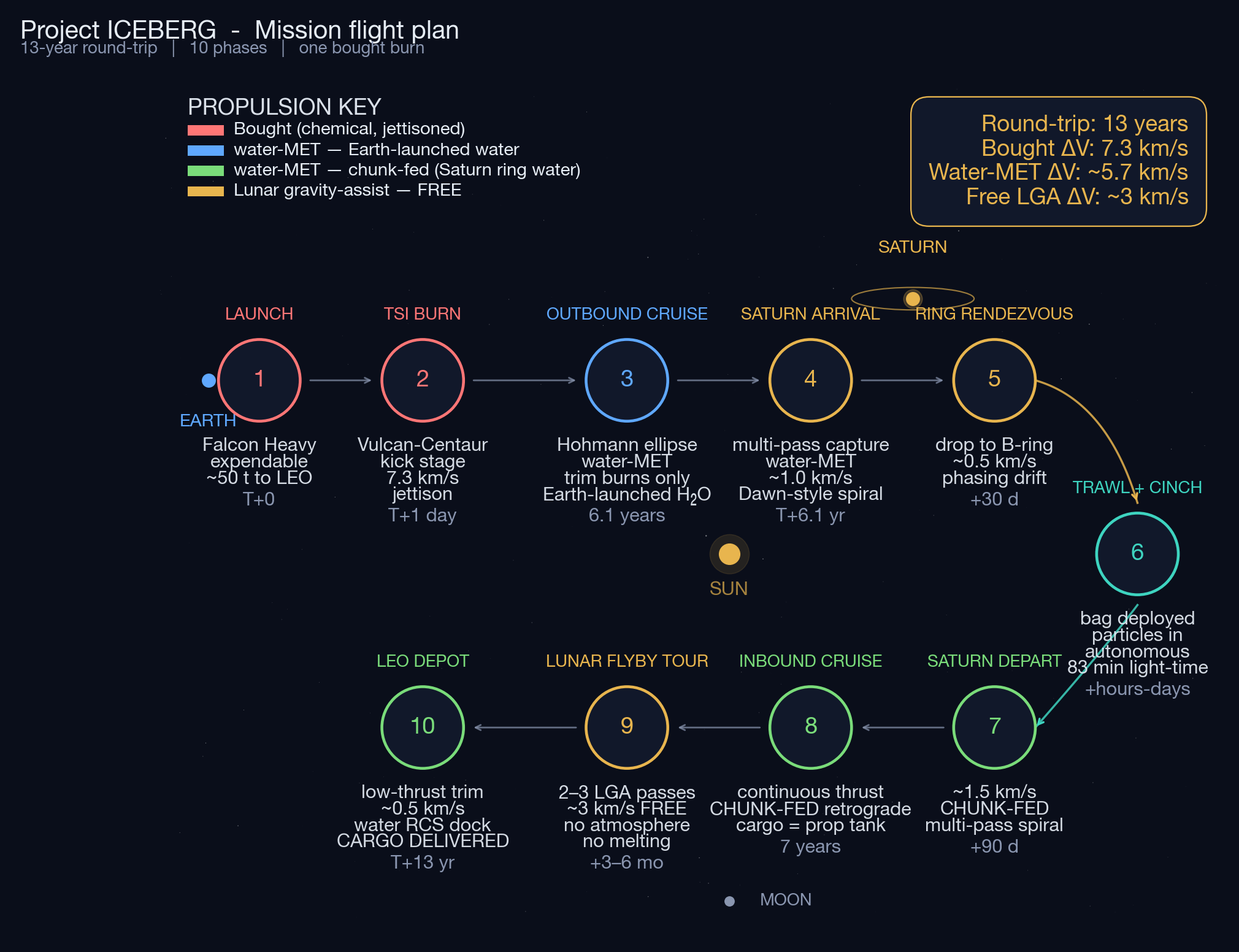
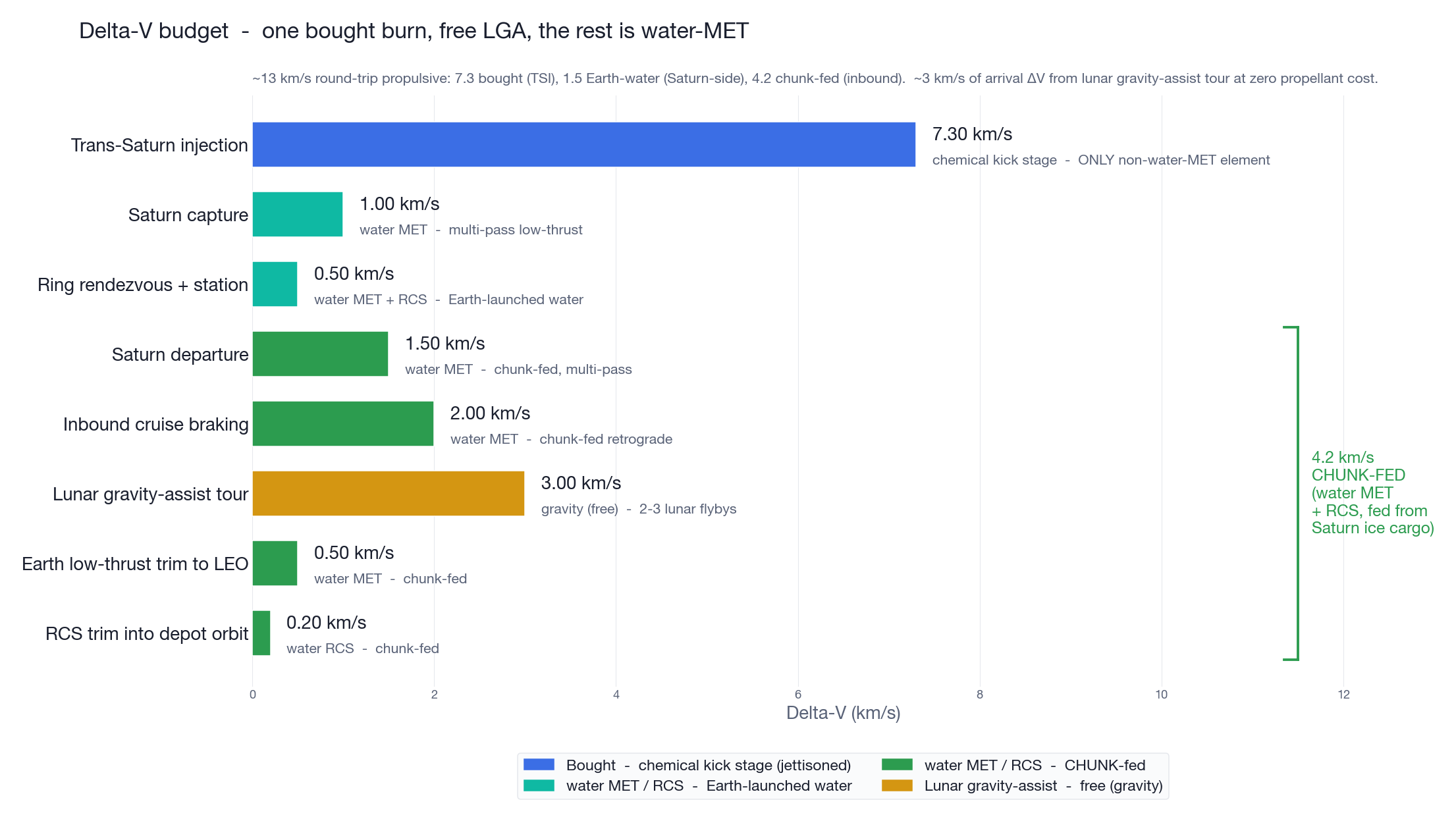
- A Falcon Heavy puts a stack of about 50 tonnes in low Earth orbit. A chemical kick stage, the only chemical propulsion on the outbound leg, performs the 7.3 km/s trans-Saturn injection and is jettisoned.
- A 6.1-year Hohmann transfer ends in capture at Saturn. The budget prices capture as one 0.8 km/s impulsive burn on Earth-launched water at a periapsis below the D ring. The model also covers a many-pass spiral capture on the water thruster, as NASA's Dawn mission flew at Vesta and Ceres.
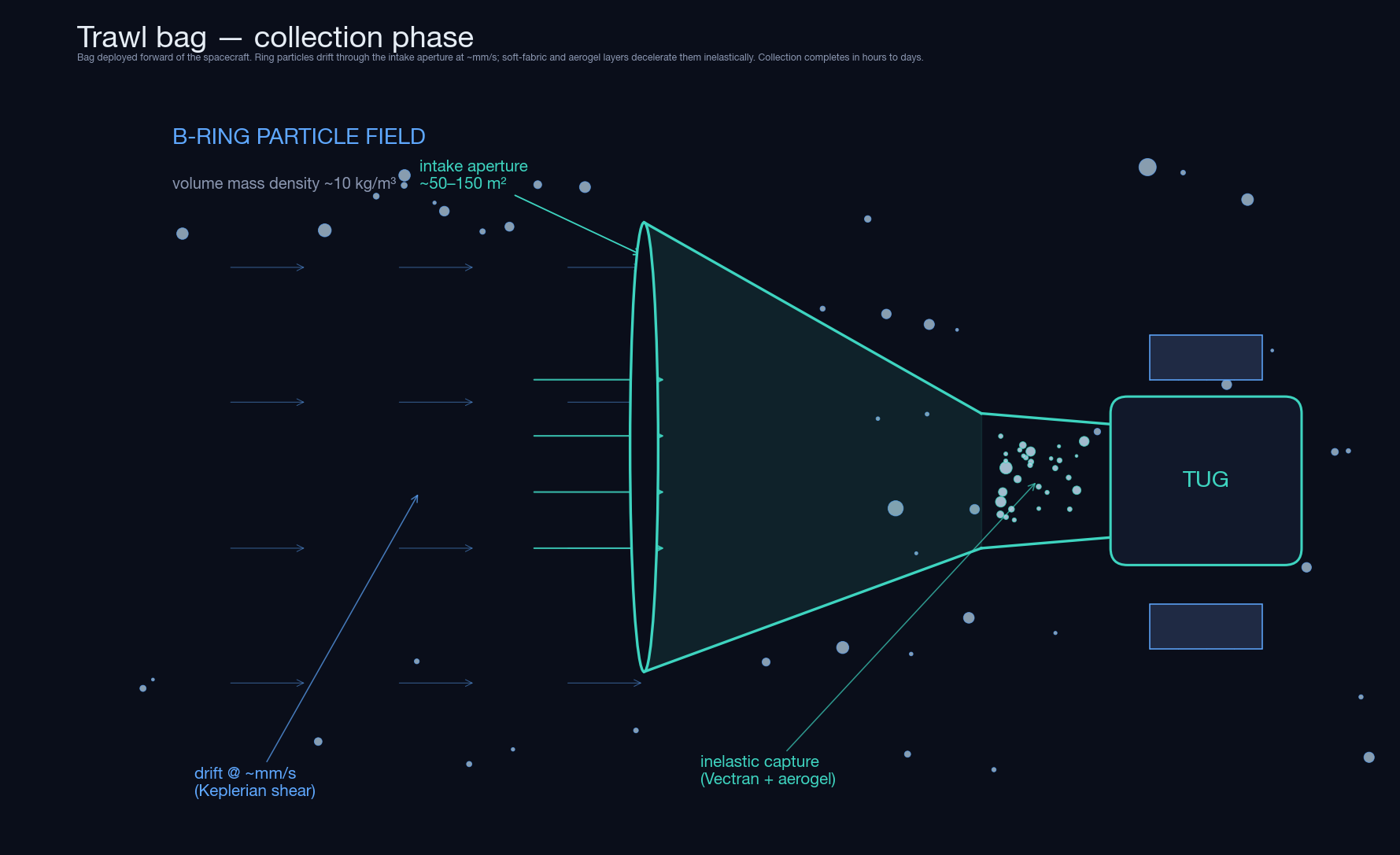
- The ship enters a circular orbit at the B-ring radius and deploys a fabric trawl bag lined with ballistic weave and aerogel. An induced radial drift of millimetres per second pushes ring material into the intake, where soft layers stop it inelastically. One-way light time is 67 to 88 minutes, so the trawl runs autonomously.
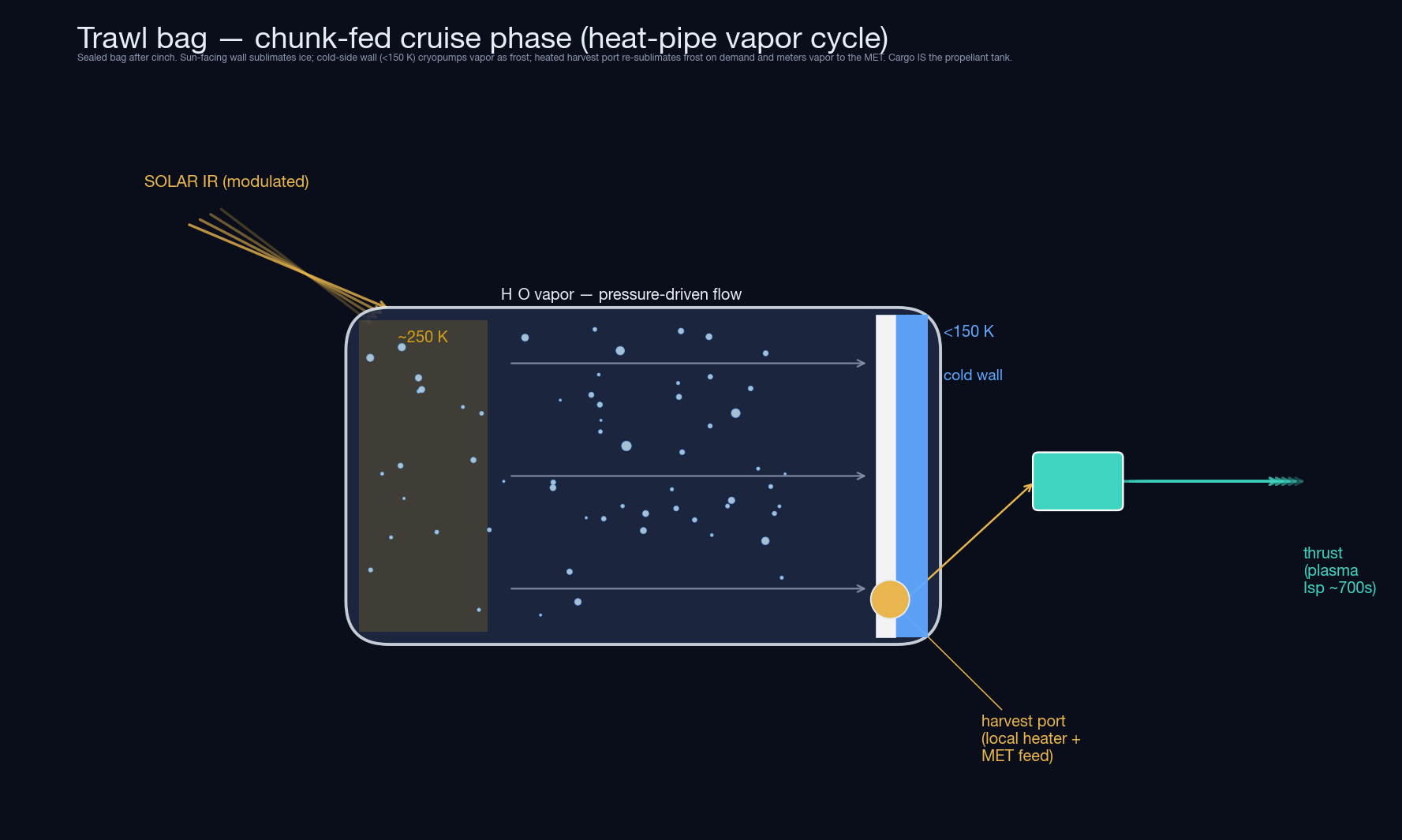
- The bag cinches shut. Ice sublimates off the sun-facing wall and refreezes as frost on the cold wall, and a heated harvest port meters vapor to the thruster on demand.
- The return starts with a multi-pass Saturn departure and seven years of continuous chunk-fed thrust. Near Earth, a tour of about fifty lunar flybys over about four years sheds 2.07 km/s and cuts arrival speed from 10.30 to 8.23 km/s. Hiten, WIND, Geotail and ARTEMIS flew tours of this kind. A low-thrust spiral then brings the ship to the depot.
The 2.07 km/s is an upper bound. A flyby rotates the ship's velocity relative to the Moon without changing its magnitude, so it can take only a small share of the Moon's orbital motion. Aerocapture is ruled out. The loaded ship's ballistic coefficient is too high to capture at any survivable periapsis, and one deep pass heats the bag to 3,100 kelvin. Aerobraking at altitudes the bag survives would sublimate the chunk many times over before it finished.
The thruster heats water vapor in a microwave resonant cavity with no electrodes or grids to erode, so it tolerates contaminated water. A NASA small-business program targeted more than 800 seconds. With water collected from the ring as propellant, that specific impulse is comparable to hydrogen-oxygen chemical rockets and about 2.5 times that of the best storable chemical propellants.
The reactor is a Kilopower derivative scaled far up, and no mission closes below about 30 kilowatts electric (kWe). An impulsive Saturn departure would need 155 to 175 kWe. The architecture flies the departure as a low-thrust spiral, which needs about 1,250 kWe because a spiral spends most of its time far from Saturn and gets no Oberth-effect gain. That is megawatt-class power, which section 5 had already rejected.
3. The bag

No sublimation-capture trawl bag has been built, and the campaign treats it as the central engineering risk. Every other subsystem (water thruster, small reactor, deep-space autonomy, lunar gravity assists) has a technology-readiness level. The bag's physics is the easiest in the design. At the 1 mm/s drift speed between ring particles, a one-metre, 500-kilogram particle enters with about 0.25 millijoules and a 10-metre, 470-tonne one with 0.25 joules. The fabric survives both energies, but a 10-metre particle does not fit through the intake. A mesh pre-screen and a lidar-triggered reject maneuver keep larger particles out.
The aerogel-lined ballistic-weave wall must lose under about 5 percent of the chunk's mass as vapor over the seven-year coast home, at 200 to 280 kelvin on the sun side, or the return runs short of delta-v. Bench tests will show if current materials need a metallized liner. Holding a stationkeeping box tens of metres across through a fill of ten hours or more costs 1 to 30 m/s by chunk size, and the delta-v budget includes it.
Capture geometry, wall aging, fill bookkeeping and harvest-port centering are bench questions; slosh of the bagged load is not. Physics rules none of them out. The staged program in section 8 relies on testing most of them on Earth at bench cost.
4. The method: pre-registered falsification rounds
Under the protocol (PROTOCOL.md) each round is a directory with a falsifiable hypothesis and numeric ranges fixed before the run, a runnable run.py, unedited results, and a Revisit section on whether the prediction held. Document-only rounds, such as citation audits and conops sketches, have the hypothesis and the Revisit section but no code. Audit rounds marked several headline decision-matrix claims RETRACTED in place.
A mission-graph tool runs a Monte Carlo of thousands of trials over the 10-phase mission, drawing each anchor (an input used without derivation, such as departure delta-v) from its plausible range. Closure means every phase is physically consistent and delivered mass clears a floor within a time ceiling. The tool reports how often the mission closes.
Parallel Claude sessions did the work; the round documents name them titan, rhea, phoebe and hyperion. A human owner set direction and locked audited findings as ground truth. I think this is a new way of doing desk studies. The first 167 rounds took about ten weeks of part-time work. My unmeasured estimate is that they would take a substantial block of analyst time by hand. Section 9 covers the method's failure modes.
5. Retracted claims
I consider the retractions below the campaign's most useful output.
| Claim | What the audit found | Status |
|---|---|---|
| Megawatt-class all-electric architecture | Radiators dominate system mass as power rises: the National Academies 2021 report puts heat rejection at about half the total system specific mass for a 200-kilowatt-electric design and warns it "has the potential to dominate over other subsystems" at higher power, and NASA's MARVL work has a fully deployed radiator array "roughly the size of a football field"; flown specific power is 5.2 watts per kilogram, paper targets assume 40 | Retired as upside-only by owner directive: "a 500-kilowatt reactor is not going to happen; stop accounting for it" |
| Low-thrust outbound delta-v of 13 km/s | The Edelbaum analytical lower bound is 27.9 km/s; the anchor was 53 percent below the floor of what physics allows | Corrected to 22 km/s; closure verdict survived because the dominant architectures use small vehicles where absolute propellant cost stays low |
| Saturn-departure delta-v of 5.5 km/s | Vis-viva re-derivation gives 7.7 km/s; a second anchor (Earth-arrival capture, 3.5 km/s) corrected to 7.3 direct, and the 4.2 credited to a lunar-flyby tour was itself falsified later, since a tour sheds at most 2.1 km/s of the arrival at any flyby count | Corrected; methodology lesson adopted: no delta-v anchor without a primary-source derivation |
| Aerocapture for the returned chunk | Ice at interplanetary arrival speed does not survive an atmosphere as a block | Ruled out; lunar gravity assist plus propulsive trim is the only intact-delivery path |
| 200-tonne commercial chunks | Overscale at flyable power; the 40-to-80-tonne band that replaced it was later shown to be inbound-leg-only accounting, and under full-round-trip closure no chunk-mass band closes at all | Retired |
| Venture-class returns | Mean expected net present value is negative; the upside is concentrated in the top decile of a clearing-price distribution the program cannot count on | Retired; reframed as regulated-utility-class infrastructure with a structural barrier to entry |
| "Suez-Canal-class business" framing | The historical Suez tariff regime is sovereign-regulated; under that regime the economics fail in 98 percent of Monte Carlo draws. The analogy only works as a scale benchmark, and the decision record annotates it as such | Annotated as internally inconsistent as originally used |
| 13-year round trip at 50 tonnes (the original pitch headline) | The canonical closed sweep delivers 39.5 tonnes in 11.93 years, best case, at corrected anchors | Superseded |
Notes left in place in the repo's pitch document flag which of its tables did not survive.
6. The dominant path
The 2026-07-27 closed-loop rerun replaced the open-loop audit sweep's 5,656 feasible paths at a 25-tonne floor with zero of 1,744. The dominant path was unchanged: two Falcon launches, autonomous assembly, a low-thrust spiral out, a chunk-fed spiral home and direct propulsive arrival. A hybrid-aerocapture variant covered the most sweep cells and was later ruled out structurally. Venus-Earth gravity assists and lunar-orbit processing waypoints never beat the dominant path, and Saturn-moon flyby captures did not either. Ships of 10 to 50 tonnes close as well as or better than the 50-to-200-tonne grid the study started with out of launcher habit.
| Delivery floor | Paths closing |
|---|---|
| 10 t (demonstrator class) | 0.0% |
| 20 t | 0.0% |
| 30 t | 0.0% |
| 50 t | 0.0% |
| 100 t | 0.0% |
The delivery floor used to decide closure more than any physics axis. Launch mass of a self-consistent ship fails first, then Saturn-departure propellant and power. The requirement document still sets a 25-tonne floor that constrains nothing.
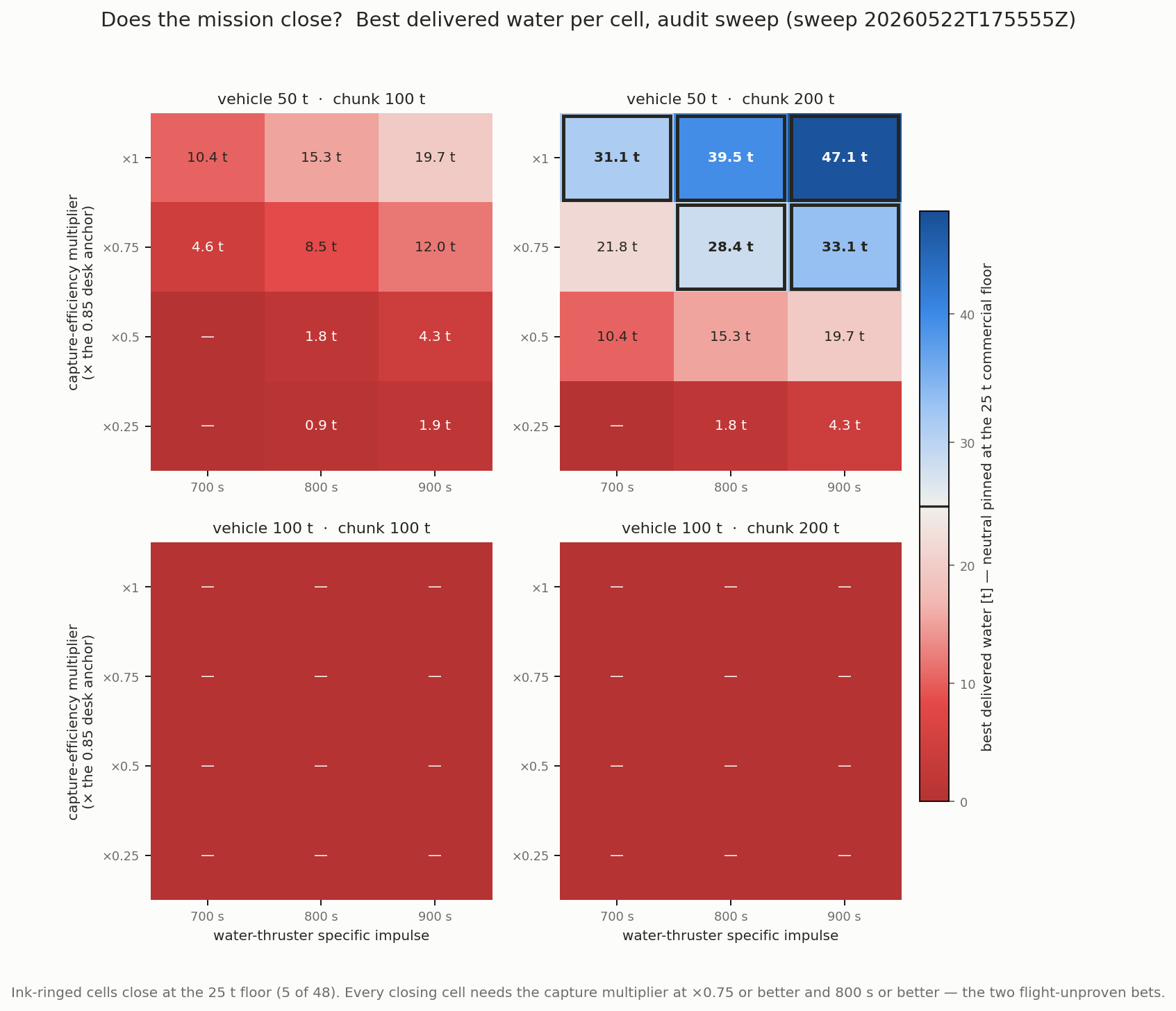
All 5 closing cells of 48 in this open-loop matrix need high capture efficiency and high specific impulse together, and neither has flown. The interactive version shows each cell's margin.
7. The bets
Bet 1: active chunk capture at scale
Closure needs all of the bets. The capture anchor assumes 85 percent single-pass capture. A bottom-up estimate gives 53 percent at millimetres per second of closing speed and 41 percent at metres per second. A flown catch-and-contain demonstrator would raise the estimate to 69 percent. Below about 75 percent of the anchor the matrix collapses. At half efficiency the best delivery drops below 20 tonnes and misses the commercial floor. Cassini flew through ring material and sampled it passively, but nobody has actively captured a multi-tonne object in a ring environment. Capture is the only one of the bets with no flight precedent at any scale.
Bet 2: continuous water electrothermal at flight scale, on ring water
The risk here is endurance. Lab microwave electrothermal thrusters reached 700 to 900 seconds of specific impulse in 50-second pulses on clean water, and Momentus has flown a water-fed one on its Vigoride-5 vehicle. The mission needs months of continuous operation through a resonant cavity on B-ring water with about 0.3 percent non-icy contaminants. The 800-second anchor sits at the inflection point of the closure curve: 100 seconds lower cuts the closure rate several-fold, and 200 seconds lower cuts it to zero.
Bet 3: a flight fission reactor, on schedule
This bet fails on programmatics. The United States has orbited one fission reactor, SNAP-10A, in 1965. The six flight programs since, including SP-100, Timberwind, Prometheus and DRACO (cancelled in 2025), cost about 1.7 billion dollars and none reached orbit. The KRUSTY ground test proved the physics in a 28-hour full-power run, and the campaign puts system-level specific power for that class at 2.4 watts per kilogram. No flight program is funded, and NASA's Fission Surface Power effort had only Phase 1 design contracts when the study closed. The campaign adds a Bayesian prior of program failure and requires a flight reactor under contract before fleet money moves.
8. The economics
The financial rounds replaced the pitch's venture-scale framing with a smaller infrastructure case: if the demonstrators win the bets, water is priced like a regulated utility. Orbital mechanics sets an eleven-year lag for a competitor that starts at the first capture, and more funding does not shorten it. The 2026-07-27 update below found that case negative.
First revenue comes more than a decade after spending starts. As one upfront commitment, the program has a negative mean expected net present value, with most of the probability in loss cases and the gains in the top decile of water prices. Staging it, with a demonstrator gate and kill criteria every couple of years and no fleet capital until Saturn capture is proven, still leaves the mean negative. The gate-0 commitment falls to about 11 percent of program capital, and the option to abandon is worth about 2.3 billion dollars against the fleet decision. The gate rule kills the fleet in 65 percent of Monte Carlo draws.
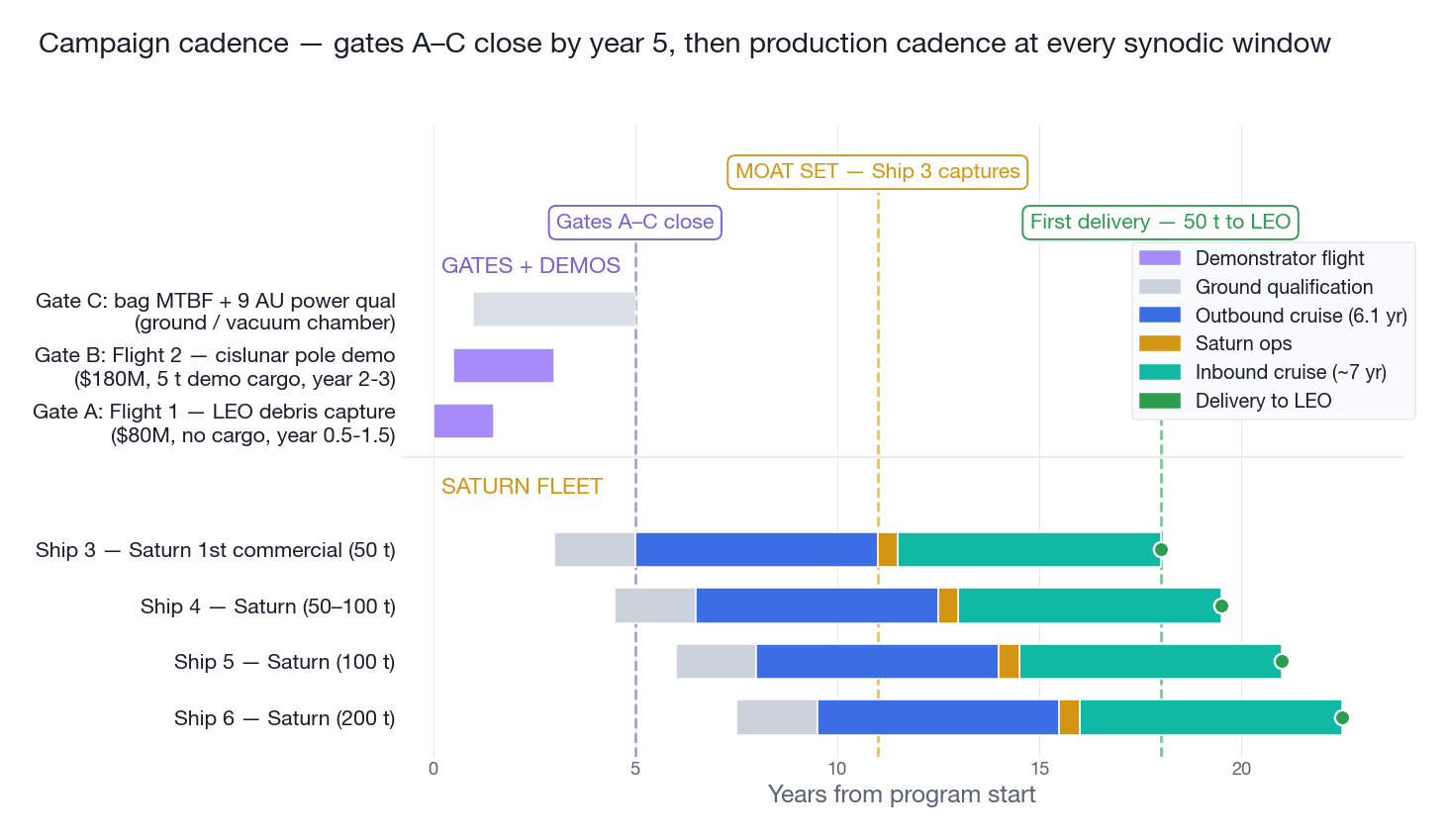
The campaign claims only that the option structure is cheap for what it buys and that the downside is bounded at the first gate. By its estimate, finding out costs three demonstrator gates of ordinary ambition.
9. The method's track record
Pre-registration with mandatory revisits made later rounds audit earlier ones, which is how the delta-v anchors were corrected and closure headlines retracted. Claims in the pitch tables fell the same way. The mission-graph tool turned checking an unusual architecture into a query. Some audit rounds ran in parallel sessions without the audited rounds' context, and one round was run twice by sessions that could not see each other's branches. The sharpest self-correction came from a session auditing its own week of work.
The method cannot test hardware, and its results are only as good as its anchors. Every closure number here is a desk-study number, sourced to public literature and swept for sensitivity. A bench test of bag-laminate permeability outranks every Monte Carlo in the repo, so the campaign puts the next dollar into hardware questions. An agent campaign writes consistent documents faster than it gathers evidence, so the number of documents can overstate how much of the analysis has been checked. The owner added the audit trail's kill directives to watch for that.
10. The verdict
This section is the verdict after 167 rounds, which could not rule the concept out and reduced it to three bets: capture the chunk, run the thruster on its water, and power the ship. The later rounds and the closed-loop accounting in the updates below ruled it out: none of 1,744 mission paths completes the round trip.
The physics of retrieving B-ring ice is mostly settled. No bet has been won. A demonstrator costing one to two orders of magnitude less than the mission could test each bet. I keep the idea classed as a long shot. I expect to reuse the method of pre-registered adversarial desk studies next month.
Update 2026-07-20: the de-spin question
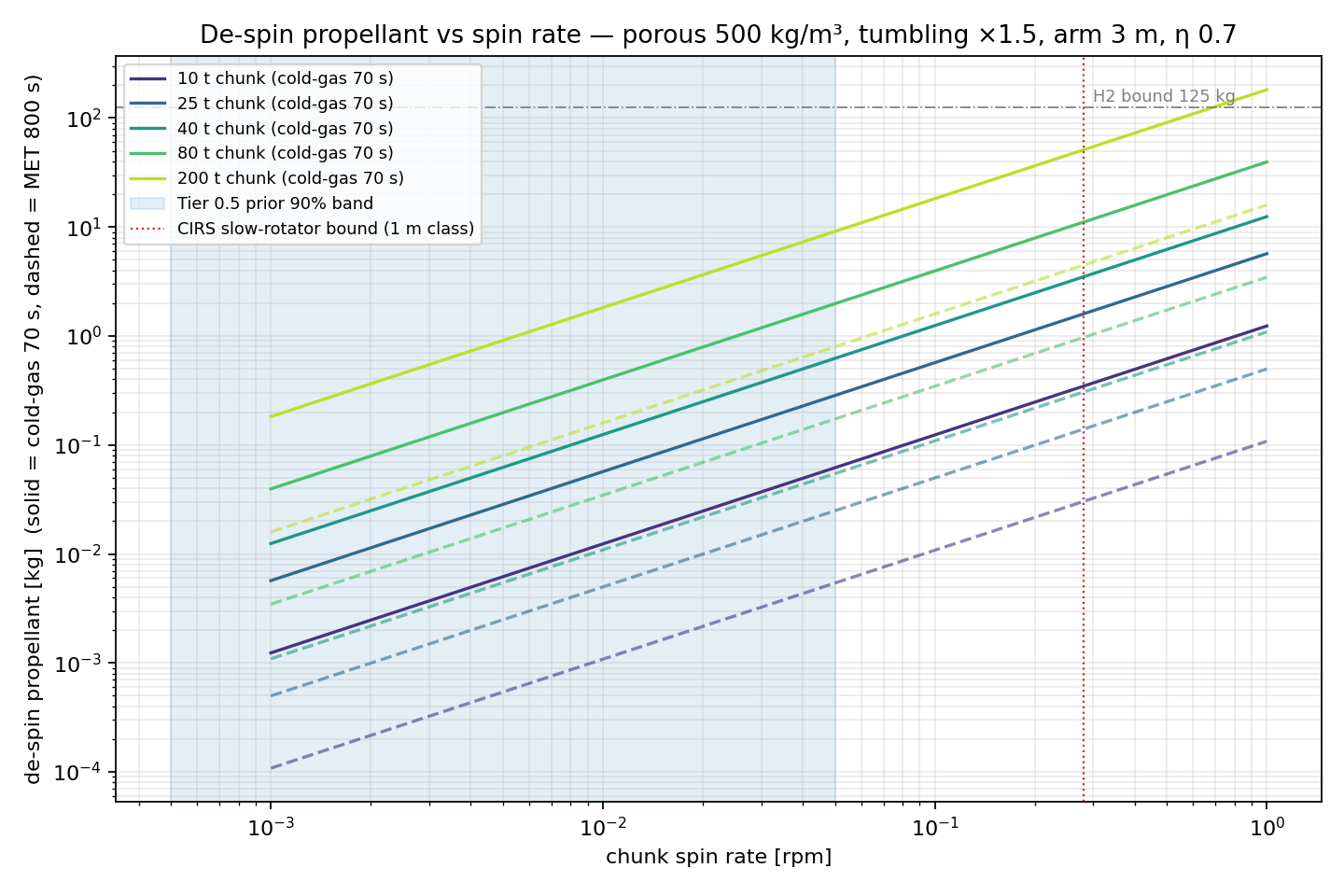
Rounds 168 and 169, run after publication at the owner's request, priced de-spinning a captured chunk. The Cassini-anchored prior puts median spin near 0.005 revolutions per minute, and de-spinning even a 200-tonne porous chunk costs grams to single-digit kilograms (R_chunk_despin_budget). Three of five pre-registered bounds failed because my estimate used the solid-ice corner of a grid whose porous corner has 1.5 times the moment of inertia, but the grams-to-kilograms result held. The round's lesson: set bounds at the grid's worst corner. Bag-fabric friction stops the spin within minutes at any plausible cinch tension and uses less propellant than thrusters. The first closure reprocess tested nothing: it read a results field that did not exist and scored every cell zero, so its pass came over an empty denominator.
The propellant cost the owner expected from spin showed up in a different mechanism, the cargo's center-of-mass walk (R_com_offset_thrust_alignment). The inbound burn draws about 40 percent of the cargo through a harvest port on one side, which moves the center of mass 1.2 to 1.7 metres off the thrust line unless the draw is actively symmetrized. Countering the torque with reaction-control thrusters costs 50 to 500 tonnes of propellant, several deliveries' worth, at any power level, because the delta-v fixes the angular impulse. Steering the thrust through the center of mass costs a cosine loss of at most 2 percent of inbound propellant: 31 to 492 kilograms for the 40-tonne chunk. On the audit sweep, steering through flips none of the five closing cells and reaction control kills all five.
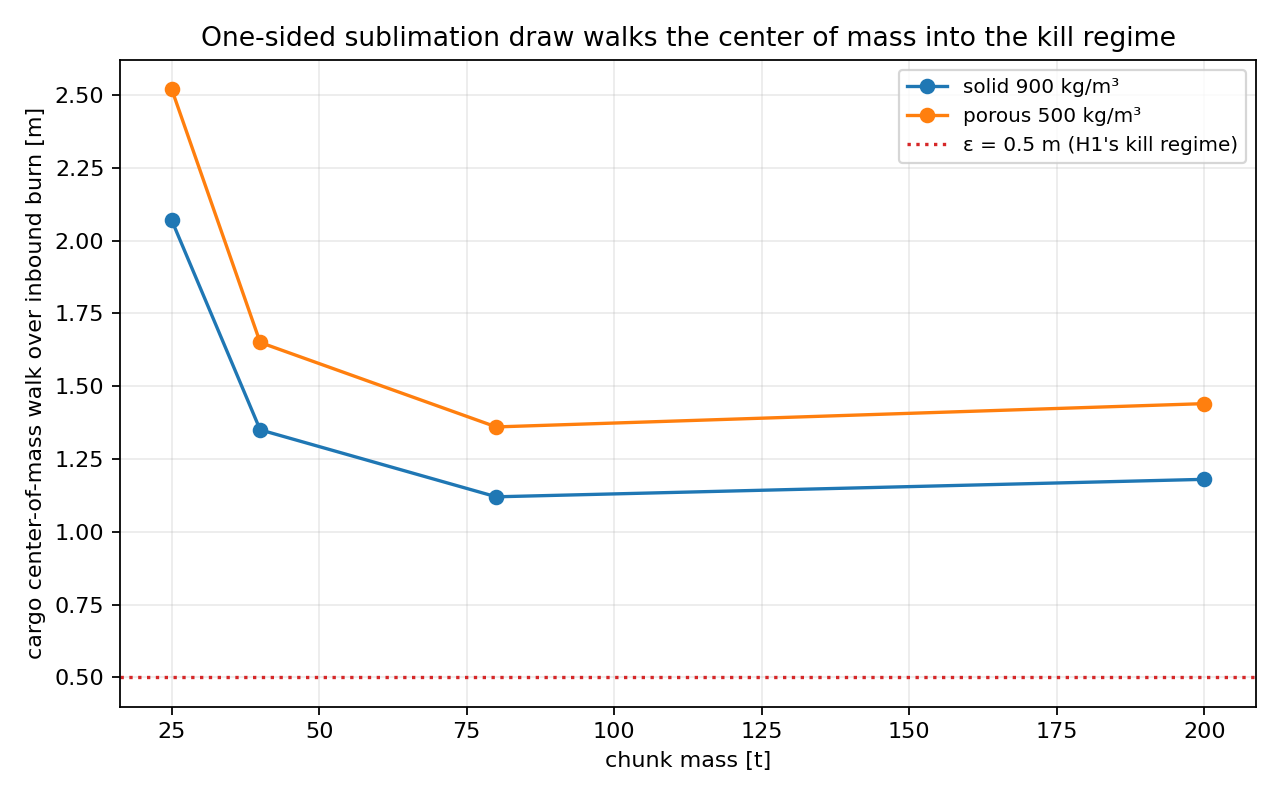
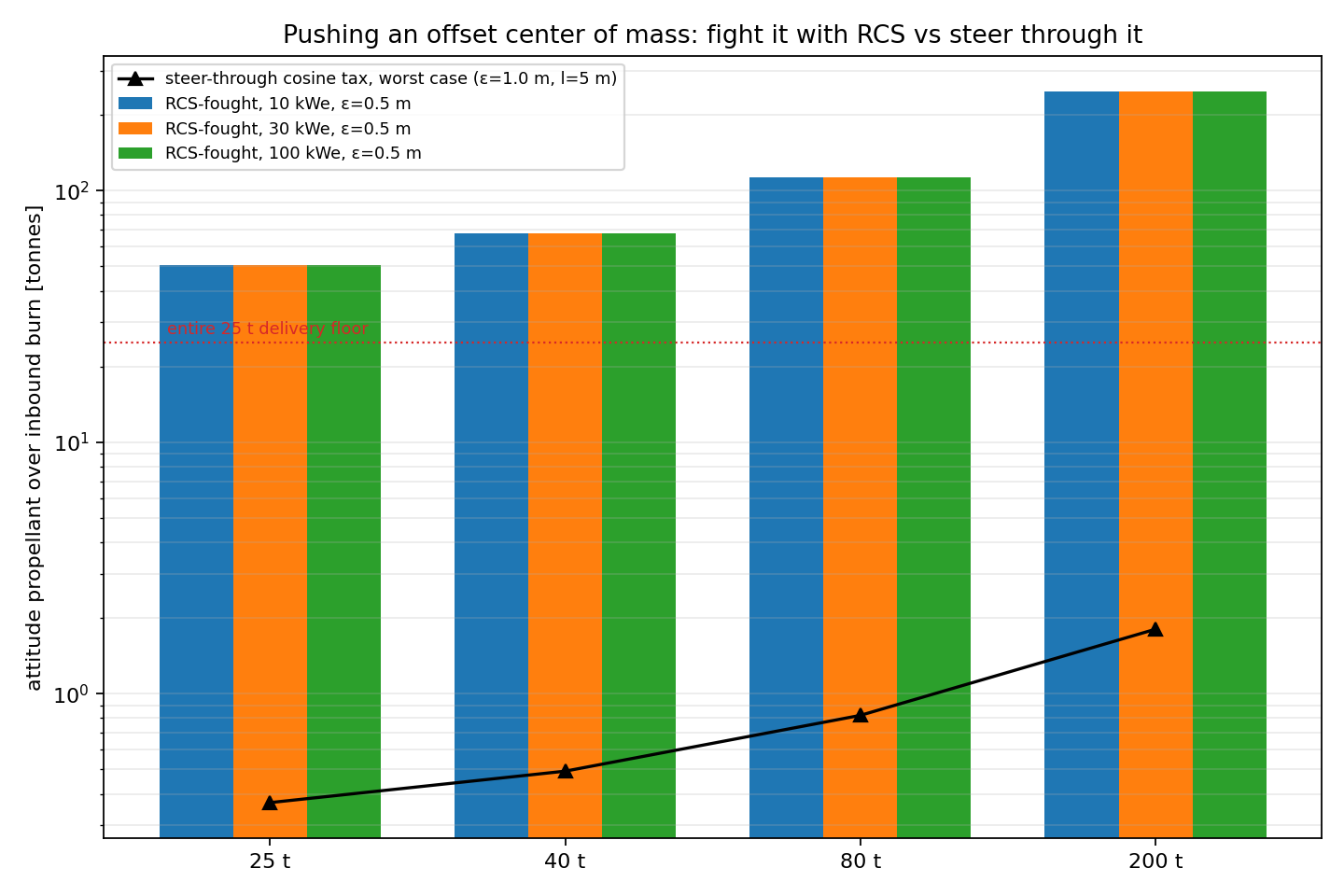
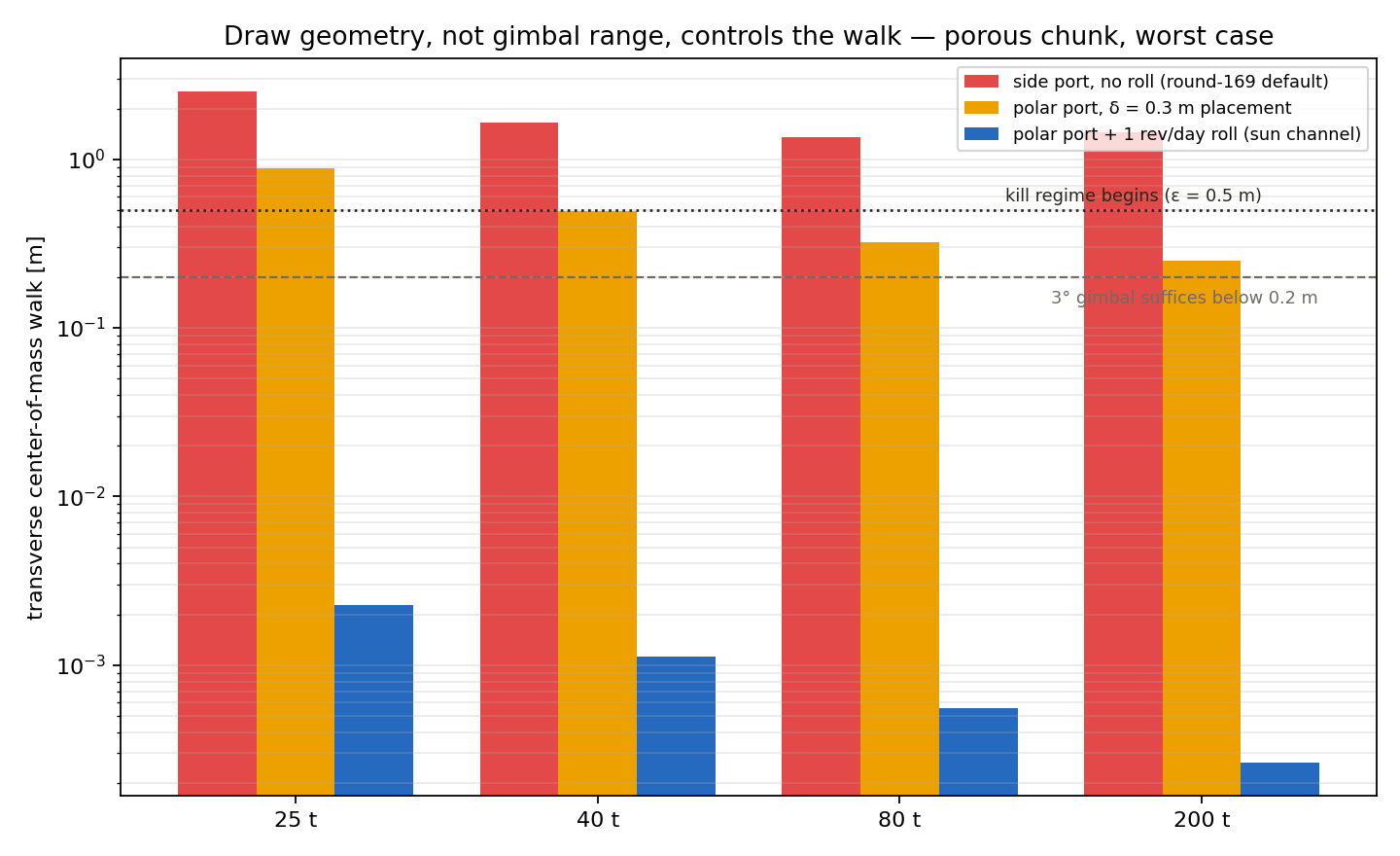
The ship must have about 12 degrees of thrust-vector authority to track a walk of plus or minus 1.7 metres, or an actively symmetrized harvest draw. The ship specification has neither.
A third round (R_harvest_draw_symmetrization) moved the harvest port onto the thrust axis and rolled the ship once a day, which cuts the walk to centimetres. The campaign's decision record adopted the resulting requirement, a 3-degree trim and a port-centering tolerance, with 12-degree tracking as the no-roll fallback. Three of the round's four pre-registered bounds failed; one miss showed that walk amplification scales with the cargo's draw fraction, so the tolerance is tightest for small chunks: at 25 tonnes the port must be centered to about 7 centimetres.
Update 2026-07-21: the campaign audits itself twice and finds a fourth bet
Most of the twenty or so rounds up to round 191 overturned earlier work. Past about 3 AU the solar array can't run the water thruster, so the owner asked whether a fuel cell running on electrolyzed cargo water could power the return. Over a six-round fuel-cell arc, the non-fission return-trip advantage rose from 1.7x to 3.3x.
R_departure_anchor_reconciliation showed the 3.3x result was false. Every round in the arc had inherited a 1.5 km/s Saturn departure delta-v from a conops-era sketch that an audit flagged in May as under-itemized. From a circular B-ring orbit, escape alone is 7.5 km/s and the impulsive minimum 8.45 km/s, so the 1.5 km/s figure the whole arc rested on was off by a factor of five. The non-fission design then needs 464 tonnes of hydrogen and oxygen staged at Saturn, a 39-to-58-times penalty, where the arc had claimed a 3.3-times advantage. A vis-viva proof withdraws the round-trip claim, and the arc's mechanisms remain as resilience components on surviving legs.
Derived from the departure burn alone, without the older chunk-moving argument, a two-year departure needs 155 to 175 kWe. That is fifteen to eighteen times the 10 kW Kilopower flight design and inside a band the campaign's credibility audit priced at under 2 percent deliverable.
One round tested a Cassini-style Titan gravity-assist tour, from a sister project on gravity-assist trajectories, to raise departure velocity for free. The ephemeris check (R_titan_tour_ephemeris) ruled it out. A flyby conserves velocity relative to Titan and orbits between flybys must stay bound, so a pure flyby chain caps the departure excess at about half what is required. Titan flybys can still deorbit a spent stage into Saturn at little delta-v cost. Bet 3 got harder: the mission's physics needs a reactor the campaign's own audit calls fantasy-adjacent.
A reader suggested a relay: a shuttle ferries chunks to a mothership farther out, so one reactor serves many missions. Over four rounds and four review passes (R_chunk_relay_staging through R_relay_ledger_reconciliation), the lifetime and net-present-value passes put it at 8.0 and 10.4 percent and the operations pass at 8.12 percent, at or just above the 8 percent utility cost of capital. The departure pass found the same 1.5 km/s error for the mothership, which put the relay below the hurdle at every setting. The relay beats the single ship, but the single-ship reactor design is back as the baseline of record.
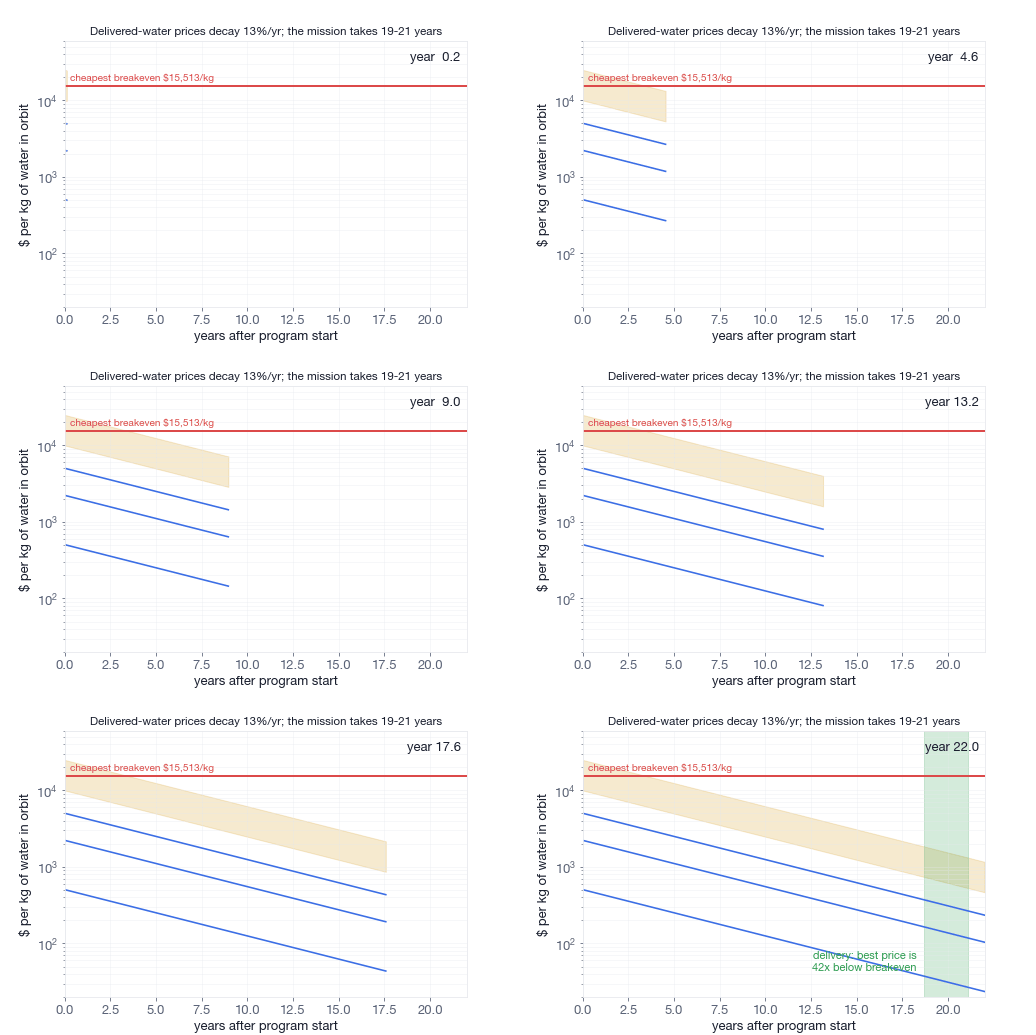
Earlier financial rounds treated the delivered-water price as a free parameter until R_clearing_price_time_path tied it to its substitutes and found a fourth bet. Water in low Earth orbit can't sell for much more than Earth-launched or lunar water. The campaign's Earth-launch anchor falls about 13 percent a year, from about $3,900 per kilogram in 2025 toward a few hundred by 2040. That is faster than either campaign discount rate, so the water is worth less than its financing cost before it arrives. Over the delivery timeline the substitute gets several times cheaper at any destination reachable from Earth. The exact rate is disputable; the campaign derived no lunar rate, and its one lunar anchor, a fixed concession off Earth launch, would follow the same curve.
The only way out is selling water in deep space, where Earth launch is prohibitive. That demand is unproven for 2032 to 2050 and won't materialize until launch is cheap, which also lowers the price nearer Earth. The three engineering bets depend on this market, and it is the one bet the mission can't influence, because it can't change the launch-cost curve.
The final rounds hardened the risk register without changing the verdict. Their numbers are desk estimates with no flight precedent, so I claim only the ranges.
One relay handoff has under 0.5 percent risk of a botched berth destroying the reactor-carrying mothership, but a mission's several handoffs raise that risk to about 2 percent centrally and roughly 8 percent at the pessimistic end. Per-chunk reliability figures don't show this program-ending loss.
A fleet can cheaply plunge spent cores into Saturn, as Cassini did in 2017. The single-ship reactor powers the return leg, so an activated core arrives in cislunar space. Cassini's precedent doesn't cover that, and nobody has costed the separability requirement or launch-and-reentry licensing it needs.
The trawl bag's 40-tonne sloshing, non-rigid load is two to ten times the mass of the ship berthing it, so its coupled-dynamics stability needed a six-degree-of-freedom simulation, which has since run. It moved the binding constraint at berth from attitude-torque authority to angular-momentum management. An off-center soft capture injects roughly 5,000 newton-metre-seconds, about seventeen times what the reaction wheels can store, and the wheel-viable case holds only for idealized mean-zero slosh.
Update 2026-07-27: closed-loop accounting and the price of water
The owner's directive for the twenty-four rounds that brought the count to 215 was to audit everything and to try to close the mission realistically and economically, or else state exactly what closure would take.
Earlier closure numbers treated the ship's dry mass as a free input. The mission-graph tool now derives dry mass from the hardware carried (reactor, radiators, tanks and capture gear) and iterates it to a fixed point. It walks a conserved mass ledger through every burn and jettison, and it requires the power available in each phase to match the powerplant on board. This accounting exposed a ship lighter than its own reactor and a kick stage built from ship hardware. One closure revival was a simulation bug and was reversed (R_closing_path_self_consistency).
None of the 1,744 end-to-end mission paths in the record-technology sweep completes the round trip. The sweep covered delivery floors of 0.5 to 25 tonnes and mission ceilings up to 35 years at every flyable power class. With relaxed ground rules, none even reaches the depot (R_l0_relaxation_envelope). A standing protocol rule came out of this: a round that claims a new closing architecture must ship a hand-checkable mass ledger, from launch mass through every burn to delivered payload, before anyone cites it. That rule has caught errors in other rounds and in mine.
R_closure_boundary_inversion pushed each performance parameter alone to an extreme (specific impulse 20,000 seconds, power a megawatt, propellant fraction 90 percent, launcher capacity 16 times today's), and none closes the mission at any value. Higher specific impulse cuts the propellant needed but stretches the burn time a given power can sustain, so closure is possible only between roughly 2,000 and 4,000 seconds. Other limits still block closure inside that range. At least three parameters must change together.
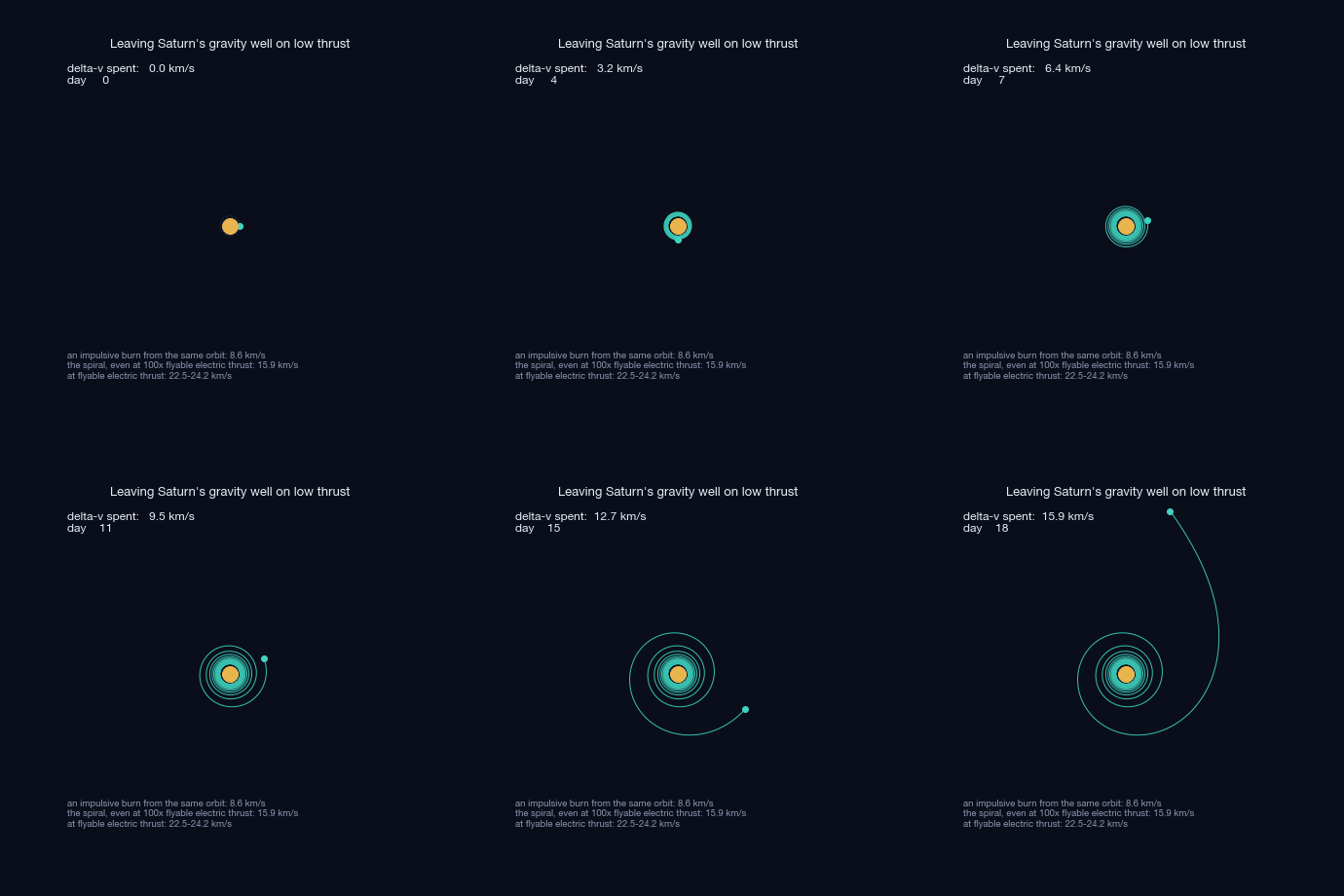
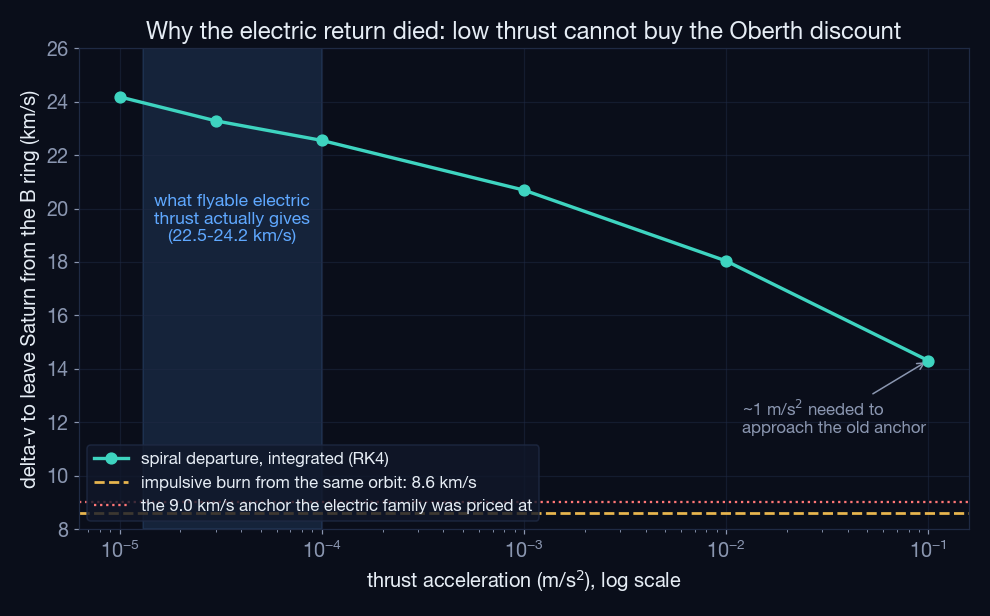
Of the two corridors that had looked closable, the electric-return corridor failed on departure. Its 9.0 km/s Saturn departure assumed an impulsive burn's Oberth gain, which a low-thrust spiral does not get. The integrated spiral (R_departure_anchor_resolution) costs 22.5 to 24.2 km/s at flyable electric thrust, about 2.5 times the 9.0 km/s anchor. Approaching 9.0 km/s would take about 1 m/s² of thrust acceleration, four to five orders of magnitude above the flyable band. Through the rocket equation, that error rules out the electric-return corridor at every launch scale the study allows.
The 8.45 km/s impulsive minimum comes from a far bi-elliptic transfer; a single burn needs 8.51 (R_departure_anchor_reconciliation). The 8.6 km/s on this page's charts is R_departure_anchor_resolution's Oberth reference from a 100,000-km residence orbit.

The protocol now requires every delta-v number to state its thrust regime. It also requires a repeated maneuver to carry its conserved quantity as state. A May round recomputed that quantity and booked 5.8 km/s of lunar-flyby braking on an Earth arrival, which violates energy conservation because a flyby sheds at most 2.1 km/s.
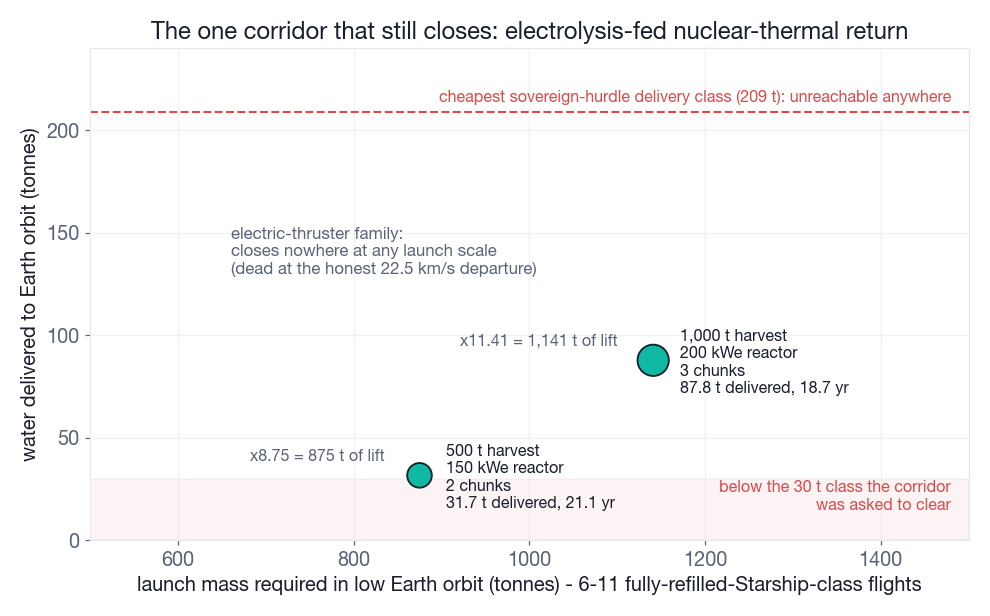
The surviving corridor harvests 500 to 1,000 tonnes of ring ice and electrolyzes part of it at Saturn. A nuclear-thermal-class engine, the only propulsion class whose specific impulse and thrust regime fit the departure, burns the hydrogen and oxygen at 750 to 900 seconds (R_saturn_water_v2_electrolysis_departure). No single admissible chunk holds enough water, so a mission needs two to three captures (R_multi_chunk_per_mission).
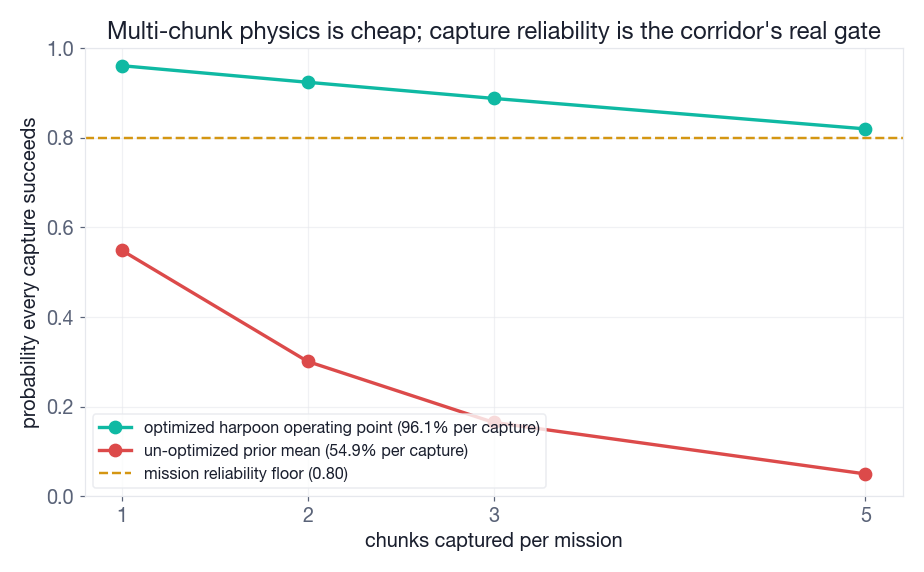
Re-rendezvous between chunks 30 to 300 km apart costs tens of metres per second, and de-spinning a 400-tonne chunk costs about a kilogram of propellant. At the optimized 96.1 percent per capture, a three-chunk mission succeeds 89 percent of the time; at the un-optimized engineering prior of 54.9 percent, it drops to 30 percent by the second chunk. Capture reliability now decides whether the mission works.
The corridor needs roughly 875 to 1,140 tonnes in low Earth orbit and a 25-year mission waiver to deliver 32 to 88 tonnes of water. That is six to eleven Starship-class flights before the tanker flights the departure kick needs. I had called this launch requirement "largely an accounting artifact" of a frozen propellant-fraction convention, and a pre-registered round (R_per_phase_propellant_fidelity) falsified that. The requirement fell from a coarse x16 to a bisected x8.75 to x11.4 because of grid granularity. The retraction is in the round document.

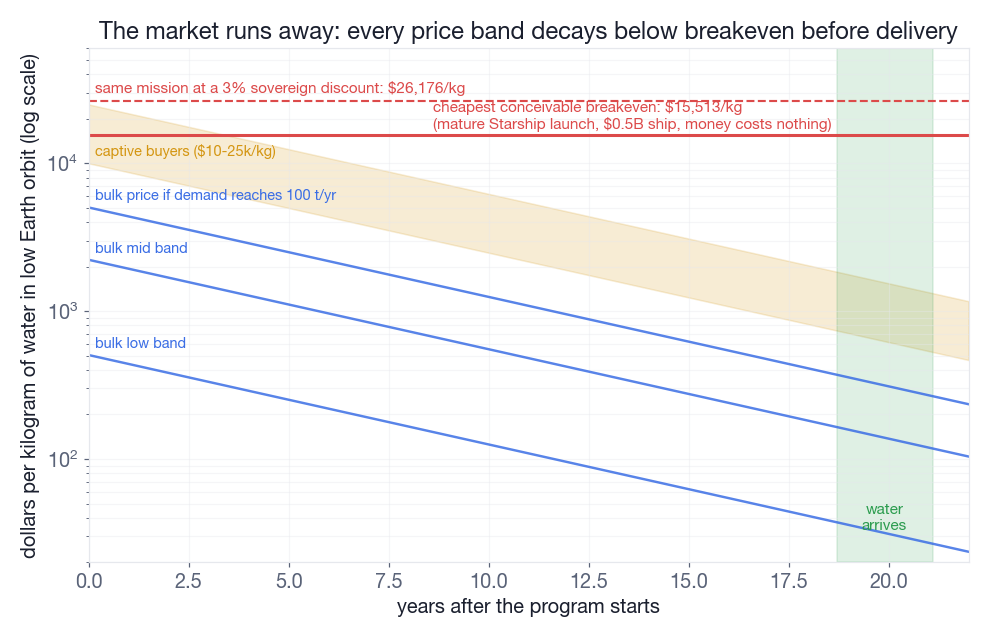
The financial model, the decision record's longest-standing open dependency, then ran (R_corridor_financial_model). At the most favorable inputs (mature Starship launch at $100 per kilogram, a $0.5 billion marginal ship, $40M a year of operations, zero cost of capital), breakeven is $15,513 per kilogram of delivered water. If orbital demand grows to 100 tonnes a year, the highest defensible bulk price is $5,025. Breakeven is $26,176 at a sovereign 3 percent discount rate and $67,912 at a corporate rate.
By arrival 19 to 21 years out, every price band has fallen to between $27 and $1,849 per kilogram, which is 10 to 100 times below breakeven. One 88-tonne delivery is about two years of the 40 to 60 tonnes of anchored annual demand. Each cost the model leaves out (program development, the reactor, mechanism qualification, insurance) would raise breakeven. The commercial case for ICEBERG on the Saturn round trip is negative. That resolves the fourth bet from the 2026-07-21 update.
Porous-ice harpoon penetration and capture-cinch reliability were already bench items. The multi-chunk work adds a bench measurement nobody has made: whether the B ring's hundred-tonne-class mass concentrations are coherent. Archival data puts 300 to 3,000 of them in each square kilometre, five orders of magnitude more than multi-capture spacing needs, but cannot tell monoliths a harpoon can anchor in from transient self-gravity-wake aggregates. Remote sensing can answer that without a flight program.
The breakeven table does not value the sovereign and science framings, so they are unaffected. The near-Earth-asteroid successor study closes its vehicle-mass loop on solar power everywhere the Saturn mission cannot, and its 8 to 11 tonne delivery is below commercial scale.
Technical details
The corpus has a concept of operations, L0/L1 requirements with a variance log, a risk register, 21 architecture-decision-record axes and 215 rounds. The curated repository snapshot has 214 round directories. A dozen are document or citation rounds with no code harness, and two hold a second execution. It ships the round documents, results, mission-graph tool and retractions. The session log and planning registry are omitted, as is the business-planning thread.
The closed-loop mission-graph tool has ~36 options, a conserved mass ledger, derived ship mass and 179 tests. The Python 3.13 code uses numpy, scipy, matplotlib and Cantera for nozzle thermochemistry, and uv manages it. Unit tests cover the physics models.
Most headline numbers trace to a round document, and the rest are marked estimates. Sensitivity sweeps are cited inline. Corrected anchors use primary sources: Edelbaum bounds, vis-viva, Cassini radiometry and LCROSS.